
You know the feeling, don’t you? You are doing everything “right.” You are blending kale smoothies that taste like lawn clippings, you are swallowing a handful of supplements that cost more than your car payment, and you are rigorously clocking eight hours of sleep. Yet, like clockwork, 2:00 PM rolls around, and you hit a brick wall. Your brain turns to mush, your eyelids feel like lead curtains, and you find yourself staring blankly at a spreadsheet, fantasizing about a nap under your desk.
It’s frustrating. It’s exhausting. And frankly, it makes you want to scream.
But here is the secret that the diet industry hasn’t told you: the problem isn’t just what you are eating. It is when you are eating it.
Welcome to the fascinating world of Chrononutrition. This isn’t just another fad diet destined to be forgotten by next summer; it is the biological blueprint for how your body was designed to function. By aligning your fork with your internal timekeeper, you can banish the afternoon slump, fix your “broken” metabolism, and finally unlock limitless daily energy.
Energy levels after lunch are heavily influenced by the quality of your previous night’s sleep — and that sleep quality is directly tied to your gut microbiome. Read our full guide on how your gut affects your sleep to understand the cycle from the other direction.
Beyond the Brain: Why Your Liver Has a Watch
Most of us think of our “body clock” as that thing in our brain that tells us when to sleep and when to wake up. Scientists call this the Suprachiasmatic Nucleus (SCN), and it is primarily set by sunlight. Think of the SCN as the conductor of a massive orchestra.
However, here is the plot twist: every single organ in your body has its own clock. Your liver, your pancreas, your gut, and even your muscles all have their own tiny timekeepers, known as “peripheral clocks.” And guess what sets their time? Food.
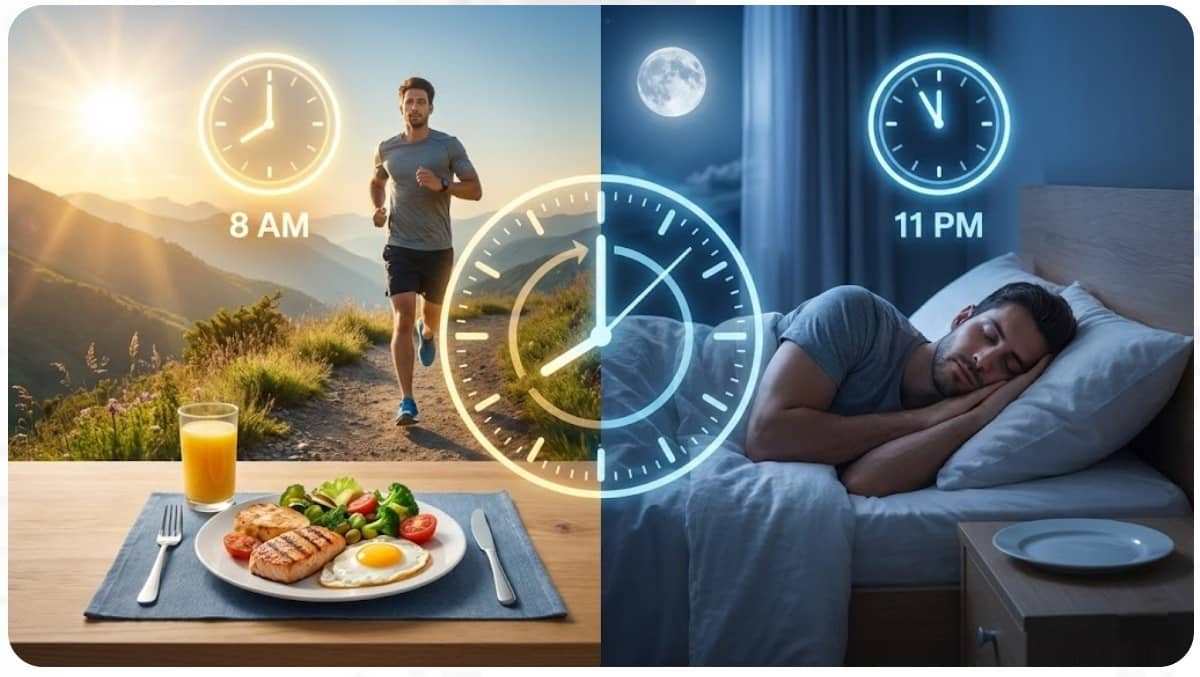
This is where the chaos begins. If you wake up at 7:00 AM (light triggers the brain) but skip breakfast and don’t eat until noon, or worse, if you raid the fridge at 11:00 PM (darkness triggers the brain) while stuffing your face (food triggers the liver), you are sending conflicting signals to your body. Your brain says “Sleep!” while your metabolism screams “Work!”
This biological confusion is called Metabolic Jetlag. It’s the reason you feel foggy, bloated, and perpetually tired, even if you never stepped foot on an airplane. Chrononutrition is simply the science of getting the conductor and the orchestra back in sync.
The Morning Protocol: The “Protein Anchor” Effect

Let’s get practical. If you want to conquer the day, you have to start strong.
When you wake up, your body releases a surge of cortisol. Now, cortisol gets a bad rap as the “stress hormone,” but in the morning, it is your best friend. It’s the “get up and go” juice. To ride this wave effectively, you need to signal to your peripheral clocks that the day has officially begun.
The best way to do this? A robust, high-protein breakfast.
Think of protein as the anchor for your blood sugar. By eating eggs, greek yogurt, or a protein shake within 90 minutes of waking, you are stabilizing your glucose levels for the rest of the day. You are telling your liver, “Okay, we are open for business.” This simple act of biological clock nutrition creates a cascade of dopamine and sustained energy that carries you through the morning without the jitters.
The Afternoon: Escaping the Sugar Crash
We have all been there. You grab a heavy pasta dish or a massive sandwich for lunch, and an hour later, you are in a “food coma.”
Here is the science: your insulin sensitivity—how well your body handles carbs—is highest in the morning and starts to nosedive in the afternoon. That means a bagel at 8:00 AM is processed completely differently than a bagel at 2:00 PM.
To master Meal Timing for Energy, try “front-loading” your carbohydrates. Eat your oats and fruits early. When lunch rolls around, focus on fiber, healthy fats, and protein. By avoiding a massive glucose spike in the middle of the day, you avoid the inevitable crash. It’s not magic; it’s just smart circadian rhythm diet management.
The Evening Danger Zone: The Melatonin-Insulin Clash

This is where most of us unintentionally wreck our health.
As the sun goes down, your brain begins to produce melatonin, the hormone that prepares you for sleep. But here is the kicker: melatonin communicates directly with your pancreas and tells it to stop producing insulin. Why? Because your body is supposed to be resting, not digesting.
If you sit down for a massive dinner at 9:00 PM or snack on chips while watching Netflix at midnight, you are flooding your bloodstream with sugar at the exact moment your body has turned off its ability to process it. The result? That sugar sits in your blood all night, wreaking havoc, storing fat, and destroying your sleep quality.
If there is one rule of Chrononutrition you follow, make it this one: stop eating three hours before bed. Give your body the grace period it needs to clean house.
The Future of Feeding: 2026 and Beyond
We are living in an era of rapid healthcare innovation, and Chrononutrition is evolving fast.
We are moving away from generic advice like “don’t eat late” toward hyper-personalized data. In the very near future, wearable tech and Continuous Glucose Monitors (CGMs) will tell you your exact “Dim Light Melatonin Onset” (DLMO). Your watch might buzz at 6:45 PM and say, “Last call for food, Dave.”
This is the next frontier of biohacking. It’s not just about weight loss; it’s about nutri-epigenetics—using the timing of your food to change how your genes express themselves, potentially slowing down aging itself.
How to Start Syncing Today (Without Losing Your Mind)
You don’t need a PhD or expensive gadgets to feel the difference. You just need a schedule.
- Set Your Window: Aim for a 10-12 hour eating window (e.g., 8 AM to 8 PM). This is often called Time-Restricted Eating (TRE).
- Eat the Sun: Get outside in the morning light and eat your biggest meals when the sun is highest.
- The Kitchen Closes Early: Tape a “Closed” sign on your fridge if you have to. Nothing good happens to your metabolism after 9:00 PM.
Reclaim Your Rhythm
At the end of the day, Chrononutrition isn’t a diet. It isn’t about deprivation or counting calories until you go cross-eyed. It is about respect. It is about respecting the ancient, biological rhythm that hums beneath your skin.
When you stop fighting your internal clock and start working with it, the results are nothing short of miraculous. The fog lifts. The fatigue vanishes. And suddenly, you have the energy to do more than just survive your day—you have the power to actually enjoy it.
So, tonight, do your future self a favor. Put down the snack, turn off the lights, and let your body do what it does best.
Ready to banish the burnout? Try the “3-Hour Rule” tonight and let us know in the comments if you wake up feeling like a new person!