
Let me take you back to a Tuesday morning somewhere around 6:47 AM. My alarm goes off. I have slept a solid seven hours. I’ve got a green smoothie waiting in the fridge. By every metric of a healthy lifestyle, I should feel like a million dollars. Instead, I feel like warm leftovers. Foggy. Sluggish. Annoyingly human.
Sound familiar? You’re not broken. You’re not lazy. You might simply be out of sync with your circadian rhythm the invisible 24-hour biological clock ticking inside every single cell in your body. And honestly? That changes everything.
Here at Healthy Wayz, we dig deep into the science that your body already knows but nobody ever explained to you properly. Today, we’re talking about circadian health what it is, why it matters more than almost any supplement or diet trend you’ve ever tried, and exactly how to reset it using three surprisingly simple levers: when you eat, when you sleep, and when you move.
| 🔑 KEY TAKEAWAY: Circadian health is the foundation beneath all other wellness habits. Get your body clock right, and almost everything else energy, metabolism, mood, immunity improves naturally. |
What Exactly Is Circadian Health And Why Should You Care?
Here’s a word you’ll want to own at your next dinner party: circadian. It comes from the Latin circa diem meaning ‘around a day.’ Your circadian rhythm is essentially your body’s internal timekeeper, a masterfully engineered biological programme that governs roughly 80% of your genes’ daily activity.
Think of it this way. Your body doesn’t just want food, sleep, or exercise it wants them at the right time. The ancient logic is elegant: wake when it’s light, eat when energy is needed, rest when it’s dark. Modern life? It laughs in the face of that logic. Late-night Netflix. Midnight snacking. Alarm clocks that drag you out of deep REM sleep. Blue-light screens at 11 PM. We’ve essentially told our body clocks to get lost.
The result? Circadian disruption and it’s quietly wrecking more than just your sleep. Researchers at Harvard Medical School have linked disrupted circadian biology to obesity, type 2 diabetes, depression, cardiovascular disease, and even accelerated ageing. This isn’t fringe wellness chatter. This is hard, peer-reviewed science.
The Master Clock and the Mini Clocks
Your master circadian clock lives in a tiny region of your brain called the suprachiasmatic nucleus (SCN) nestled in the hypothalamus, just above where your optic nerves cross. It reads light signals from your eyes and coordinates the entire biological show.
But here’s what’s genuinely mind-blowing: every organ in your body has its own peripheral clock your liver, gut, muscles, skin, even your immune cells all run on their own local timetables. When these peripheral clocks fall out of sync with the master clock a state scientists call circadian misalignment your body starts working against itself. Your liver is expecting a meal. Your gut is already shutting down digestion. Your muscles are ready to move but your brain is still in sleep mode. Chaos, basically.
| 💡 SCIENCE SNAPSHOT: A 2023 study published in Nature Metabolism found that circadian misalignment reduced insulin sensitivity by up to 34% independent of sleep duration. You can sleep eight hours and still wreck your metabolism by eating at the wrong time. |
The Eating Window: Why When You Eat Matters More Than What
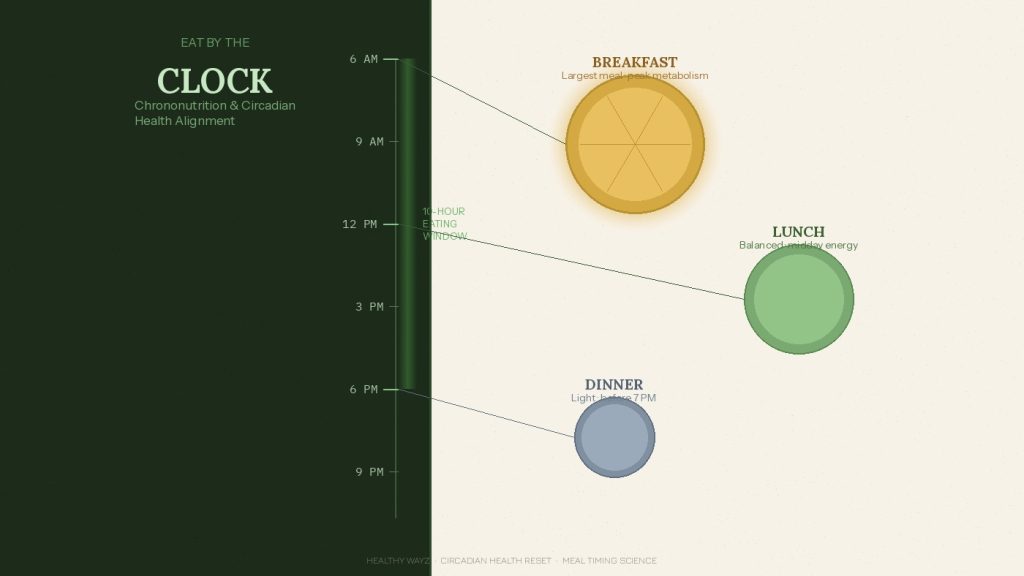
I used to obsess about macros. Protein grams, carb cycling, fasting windows measured to the minute. Then I stumbled across the research on chrononutrition the science of aligning your meals with your body clock and it reframed everything. Your digestive system is not on call 24/7. It has peak hours, and ignoring them is a bit like ringing your dentist at 2 AM and then wondering why the service feels off. The science behind this eating window is explored in depth in our guide on chrononutrition and meal timing, which breaks down exactly how your gut clock responds to food signals throughout the day
Your Metabolism’s Golden Hours
Research led by Dr. Satchin Panda at the Salk Institute one of the world’s leading circadian biology researchers consistently shows that the body’s metabolic machinery is sharpest in the morning and early afternoon. Insulin sensitivity peaks before noon. Digestive enzyme activity is highest midday. The gut microbiome has its own timed rhythms that optimise nutrient absorption during daylight hours.
Translation: the same 500-calorie meal eaten at noon will be processed significantly differently by your body than the same meal eaten at 10 PM. This is what time-restricted eating or TRE is really about. It’s not a crash diet. It’s eating in harmony with your circadian biology.
Practical Circadian Eating: The 10-Hour Window
The sweet spot most research points to is a 10-hour eating window that aligns with daylight. That means if your first meal is at 8 AM, your last meal wraps up by 6 PM. Not a hard rule life is gloriously inconvenient but a solid target for metabolic health and circadian alignment.
- Front-load your calories eat your biggest meal at breakfast or lunch, not dinner
- Avoid eating within 3 hours of bedtime to protect your sleep quality and gut circadian rhythm
- Time your protein a protein-rich breakfast activates muscle synthesis pathways that are most receptive in the morning
- Respect your overnight metabolic fast 12–14 hours without food gives your gut lining time to repair
- Hydrate early your cortisol awakening response in the first 90 minutes of waking is your natural energy peak; support it with water, not caffeine
| 🗣️ REAL TALK: One reader from our community, Priya, shifted her dinner from 9 PM to 6:30 PM for three weeks without changing a single food. Her words: ‘I lost 4 lbs, my afternoon energy improved and I stopped waking up at 3 AM.’ That’s circadian health in action no supplements required. |
The Sleep Architecture Reset: More Than Just Hours in Bed
Sleep is not a passive recovery state. It is aggressively active biology and your circadian clock is the conductor. While you’re happily unconscious, your brain is clearing toxic waste through the glymphatic system, your immune system is calibrating, your growth hormone is peaking, your memory is being consolidated. Get the sleep-wake cycle timing wrong and none of this happens with full efficiency even if you get eight hours.
The Light-Melatonin Connection You’re Probably Ignoring
Your circadian rhythm is primarily synchronised by light specifically, blue wavelength light that hits your retina and signals to your SCN whether it’s day or night. Morning sunlight is the most powerful circadian zeitgeber (that’s German for ‘time-giver’) there is. Evening blue light from screens is the most powerful circadian disruptor most people encounter daily.
Here’s the biology: melatonin your body’s darkness hormone normally begins rising about 2 hours before your natural bedtime. Even 10 minutes of bright screen exposure can delay that rise by 90 minutes. You’re not having a sleep problem. You’re having a light timing problem.
Your Circadian Sleep Protocol
- Get outside within 30 minutes of waking natural morning light (even cloudy) anchors your circadian phase more powerfully than any supplement
- Dim indoor lights after 8 PM swap overhead lighting for warm, low-intensity lamps to allow natural melatonin synthesis
- Maintain a consistent sleep-wake schedule even on weekends. Social jetlag (sleeping 2+ hours later on weekends) is a documented circadian disruptor
- Keep your bedroom cool (65–68°F / 18–20°C) core body temperature drop is a biological sleep trigger
- Avoid alcohol within 3 hours of bed it fragments REM sleep and suppresses restorative circadian processes
Once you have your circadian timing right, the next layer is calming your autonomic nervous system before bed. Our full guide on how to reset your nervous system for sleep gives you the breathwork and body-based tools that make this work in practice.”
One more thing and I cannot stress this enough. Stop treating weekends as a sleep debt payback scheme. ‘Catching up on sleep’ on Saturday does not undo the circadian rhythm disruption created by five days of inconsistent schedules. Your body clock doesn’t work like a bank account. It works more like a garden it needs consistent, daily tending.
Movement Timing: Exercise That Works With Your Biology
Raise your hand if you’ve ever dragged yourself to a 6 AM workout out of guilt and then wondered why it felt absolutely brutal. You’re not weak. You might just be fighting your chronotype the biologically-determined preference your body has for when it wants to sleep, wake, and perform physically.
Timing your exercise to align with your circadian biology is a genuine performance advantage. A 2021 study in the Journal of Physiology found that morning exercise shifts your circadian clock earlier, improving sleep quality and metabolic health particularly for evening chronotypes who struggle to wind down at night.
Sleep quality is not just controlled by your brain and circadian timing your gut plays an equally powerful role. If you have not read our deep-dive on the gut-sleep connection, that is the next logical piece of this puzzle.
Matching Exercise to Your Circadian Window
Morning exercise (6–10 AM): Best for fat oxidation, establishing circadian phase, improving insulin sensitivity. Particularly effective for people who want to lose weight or improve metabolic health.
Midday exercise (12–2 PM): Optimal for cardiovascular performance and coordination. Body temperature is rising, reaction time improves, injury risk drops.
Late afternoon exercise (4–6 PM): Peak time for strength, power output, and muscle protein synthesis. Athletes and gym-goers often hit personal records in this window. Body temperature and cortisol rhythm both support high-intensity work here.
Evening exercise (after 8 PM): This is where it gets complicated. Late intense exercise can delay melatonin release and disrupt sleep onset. Light yoga or walking is fine; heavy HIIT at 9:30 PM will cost you your next day’s energy. ‘Pairing circadian timing with a targeted nervous system reset amplifies both. Read: Calm Your Nervous System Tonight.
| ✅ QUICK WIN: If you can do just one thing differently starting tomorrow step outside for 10 minutes of natural light within the first 30 minutes of waking. This single habit is the most evidence-backed circadian anchor there is. Free. Immediate. Profoundly effective. |
The Four Pillars of a Circadian Health Reset
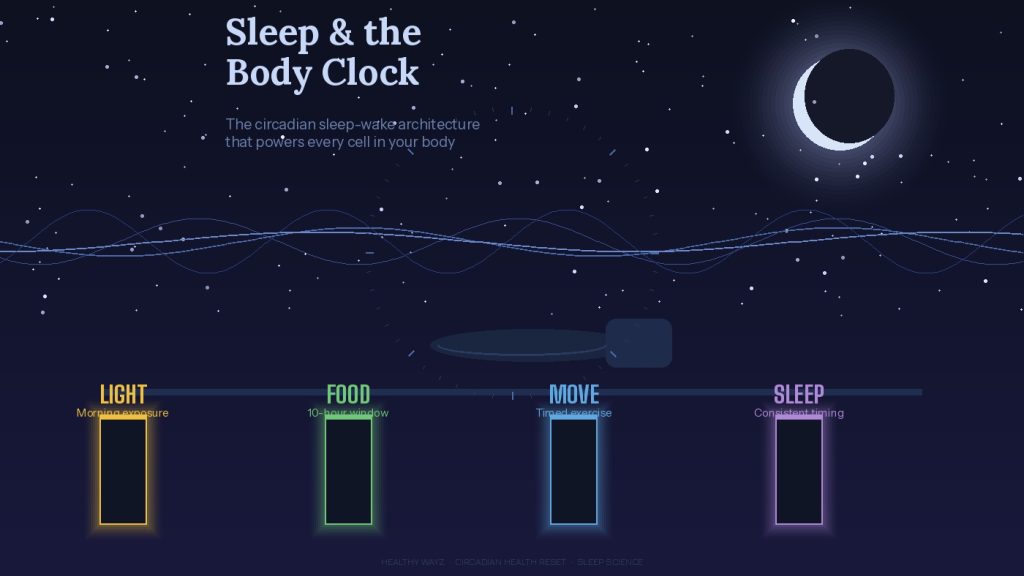
If you want to actually reset your circadian rhythm rather than just read about it, here is the integrated framework. Think of it as a 4-pillar system where each element reinforces the others:
Pillar 1: Light Your Circadian Anchor
Morning bright light within 30 minutes of waking. Evening light dimming after 8 PM. This is the non-negotiable foundation of every circadian health protocol.
Pillar 2: Food Timing Chrononutrition in Practice
A consistent, daylight-aligned eating window. Front-loaded calories. No late-night meals. Your gut microbiome, liver, and pancreas all depend on this timing signal to stay synchronised with your master clock.
Pillar 3: Movement Timed Physical Activity
Any daily movement helps, but timed exercise (morning or early afternoon for most people) amplifies circadian entrainment and supports metabolic flexibility.
Pillar 4: Sleep Consistency The Non-Negotiable Reset
Same bedtime, same wake time, every day. This is what anchors your circadian rhythm and allows every other biological process immune function, hormone production, cognitive performance to run on schedule. Consistent sleep timing is one of the most evidence-backed interventions in the broader field of biohacking your sleep for longevity, alongside HRV tracking and hormetic stress protocols.
Content Gap Reality Check: What Nobody Else Is Telling You
Here’s something worth saying plainly. Most major health websites give you the what but skip the when. They’ll tell you to eat more fibre, exercise more, and sleep better and all of that is genuinely good advice. But circadian health science adds a dimension most mainstream wellness content completely ignores: biological timing.
Your body is not just a calories-in, calories-out machine. It is a time-sensitive biological system that evolved in rhythm with the sun. Eating, sleeping, and moving in harmony with that rhythm isn’t biohacking. It isn’t extreme. It’s simply living the way your biology was designed to function.
The exciting news? You don’t need expensive gadgets, specialist labs, or an extreme diet overhaul to begin. You need three things: consistent light exposure in the morning, a roughly timed eating window, and a regular sleep schedule. Start there. The rest is refinement.
Frequently Asked Questions About Circadian Health
What is circadian health in simple terms?
Circadian health refers to how well your body’s internal 24-hour biological clock is synchronised with your behaviour and environment including when you eat, sleep, and exercise. When these align, your body performs at its biological best.
How long does it take to reset your circadian rhythm?
Most people notice meaningful improvements in energy, sleep quality, and digestion within 7–14 days of consistent circadian-aligned habits. Full circadian rhythm reset particularly after significant disruption like shift work or jet lag typically takes 3–4 weeks of consistent practice.
Does circadian rhythm affect weight loss?
Yes significantly. Circadian misalignment directly impairs insulin sensitivity, increases hunger hormones (particularly ghrelin), and disrupts fat metabolism. Multiple clinical trials have demonstrated that time-restricted eating within a circadian-aligned window produces measurable improvements in body composition, independent of calorie intake.
What’s the best time to eat for circadian health?
Front-load your nutrition. A circadian-aligned eating pattern typically means a 10–12 hour window starting within 1–2 hours of waking, with the largest meal at breakfast or lunch and the lightest meal at dinner. Avoid food within 2–3 hours of your target bedtime.
Is intermittent fasting the same as circadian eating?
Not exactly. Circadian nutrition (sometimes called chrononutrition) specifically emphasises daylight-aligned eating windows not just any fasting window. A midnight-to-noon eating window is technically intermittent fasting but circadian misaligned. Timing matters as much as duration.
Your Circadian Health Reset Starts Tonight
Here’s what I want you to take away from this. Circadian health is not another wellness trend that will be replaced by something shinier next January. It is foundational human biology the architecture beneath every other health habit you’ve ever tried. And the remarkable thing is: your body already knows exactly what to do. It just needs you to stop fighting the clock.
Tonight, dim your lights an hour earlier than usual. This week, try eating your last meal before 7 PM. Tomorrow morning, step outside within the first 30 minutes of waking and let natural light reach your eyes. These aren’t dramatic interventions. But they are circadian resets and compound over weeks into genuinely transformative improvements in how you feel, think, sleep, and move.
At Healthy Wayz, we believe the most powerful health transformations are often the quietest ones. Not the loudest supplements or the most extreme diets. Just your body clock, finally working with you instead of against you. Because every body clock runs slightly differently, combining circadian principles with personalized nutrition based on your biology including DNA profiling and microbiome mapping creates the most precise and effective health strategy available today.
Welcome to your reset. 🌿
References & Further Reading
- Panda, S. (2020). The Circadian Code. Rodale Books.
- Chaix, A., et al. (2019). Time-Restricted Eating to Prevent and Manage Chronic Metabolic Diseases. Annual Review of Nutrition.
- Poggiogalle, E., et al. (2018). Circadian regulation of glucose, lipid, and energy metabolism in humans. Metabolism.
- Asher, G. & Sassone-Corsi, P. (2015). Time for Food: The Intimate Interplay between Nutrition, Metabolism, and the Circadian Clock. Cell.
- Serin, Y. & Acar Tek, N. (2019). Effect of Circadian Rhythm on Metabolic Processes and the Regulation of Energy Balance. Annals of Nutrition and Metabolism.
About the Author
Aziz Q. Shaikh is the founder and lead content strategist at Healthy Wayz, based wellness platform dedicated to evidence-informed, human-first health guidance. Aziz writes at the intersection of circadian biology, nutrition science, and practical wellness making complex research accessible, actionable, and genuinely useful for everyday readers. This article has been reviewed for scientific accuracy by a registered nutritionist.