
| Quick Summary The gut-sleep connection is a two-way system. Poor gut health breaks sleep. Poor sleep destroys your gut. Fix one and you start fixing both. 90% of your serotonin is made in your gut, not your brain. That serotonin is the raw material for melatonin, your sleep hormone. The 4-week gut-sleep reset protocol in Section 5 rebuilds both systems at once. Start with Week 1 tonight. |
Why Your Gut and Sleep Are the Same Problem
Wednesday morning. Bed at 10pm. Eight full hours of sleep. Two alarms, just in case.
I woke up feeling like I had been hit by a bus.
And my stomach was already complaining before I found my glasses.
For months I treated those two problems as separate things. The tired thing. The gut thing. Turns out they are the exact same loop, and most doctors never mention it.
The gut-sleep connection is the relationship between your digestive system and your sleep quality. It runs in both directions. A damaged gut ruins sleep. Bad sleep damages your gut. You cannot fully fix one while the other is broken.
This post explains the science without the jargon. Then it gives you a real plan to reset both at once. No supplements to sell. No vague advice.
| Quick (3-line summary) Your gut makes 90% of your serotonin and most of your melatonin precursors. Poor sleep breaks your gut lining. A broken gut keeps you awake. Both problems share one root. The 4-week protocol in Section 5 fixes the gut-sleep connection directly. Start with Week 1 tonight. |
What Is the Gut-Sleep Connection? The Science Without the Jargon
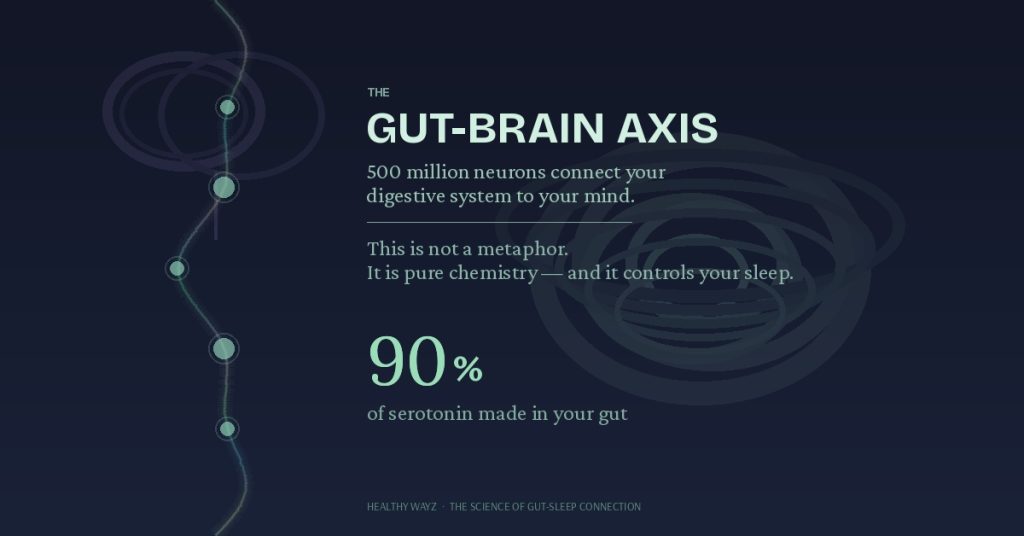
Your gut and your brain are in constant conversation. The channel they use is called the gut-brain axis, the nerve network connecting your digestive tract to your mind. It contains roughly 500 million neurons.
That is not a typo. Your gut has its own nervous system. Sometimes called the second brain, it does more than digest food. It produces hormones, signals your brain about stress, and plays a direct role in whether you sleep soundly or stare at the ceiling until 3am.
Your Gut Makes the Chemicals That Put You to Sleep
About 90% of your body’s serotonin is produced in your gut, not your brain. Serotonin converts into melatonin, the hormone that signals your body it is time to sleep. When your gut microbiome is out of balance, serotonin production drops. When serotonin drops, your body does not make enough melatonin. And when melatonin suffers, sleep suffers.
This is not a wellness metaphor. It is pure chemistry.
A 2023 Cell Host and Microbe study found that specific gut bacteria control the chemical chain that produces your melatonin. When those bacteria are depleted, sleep architecture measurably changes. Less deep sleep. More fragmented REM. More waking through the night.
Your Gut Runs Its Own Circadian Clock
Your circadian rhythm is not just in your brain. Your gut bacteria follow their own 24-hour schedule. They shift their behaviour based on when you eat, when you move, and when you sleep.
Think of two musicians. In sync, the music is clean. Off by one beat, both fall apart.
When your sleep schedule is erratic, your gut microbiome becomes erratic too. It sends stress signals back to the brain that make quality sleep even harder to reach. This is why shift workers and frequent travellers consistently report worse gut health and sleep than people with regular schedules. Same root cause.
How Poor Sleep Destroys Your Gut (And Vice Versa)
Poor gut health and sleep do not just fail independently. They actively make each other worse. Here is the loop.
[CHANGE: “Here is where the loop becomes vicious” removed over-dramatised. Replaced with clean 2-sentence setup.]
Sleep Deprivation Makes Your Gut Lining Leaky
Sleeping fewer than six hours regularly makes your gut lining leaky. Bacteria, food particles, and inflammatory compounds that should stay inside your digestive tract start crossing into your bloodstream.
Your immune system responds by producing inflammatory molecules, including IL-1 and TNF-alpha. These molecules specifically suppress deep, slow-wave sleep while pushing you into lighter, less restorative stages.
You sleep badly. Your gut gets more inflamed. More inflammation keeps you awake. Round and round. Many people still believe gut problems and sleep problems are two unrelated issues one of the most persistent common health myths our experiments have tested directly.
A Disrupted Gut Raises Your Cortisol at Night
When your gut bacteria are imbalanced, a condition called gut dysbiosis, your body produces more cortisol. Cortisol is a wake-up signal. When gut problems keep it elevated after 10pm, your body physically cannot sink into deep sleep stages.
A 2024 Frontiers in Psychiatry review linked low gut Lactobacillus directly to high night-time cortisol, insomnia, and next-morning anxiety.
Are You Caught in the Gut-Sleep Cycle? Check These Six Signs
If your gut and sleep are both disrupted, the most effective starting point is often calming the autonomic nervous system itself. Our guide to nervous system reset for better sleep gives you the complete evening protocol.
These six symptoms suggest your gut and sleep problems are connected:
- You wake tired even after a full night of sleep
- Bloating or digestive discomfort hits in the evening or overnight
- Falling asleep takes over 30 minutes despite physical exhaustion
- Your gut symptoms flare after a run of poor sleep
- Morning anxiety or irritability arrives with no obvious trigger
- Energy crashes consistently between 2pm and 4pm
Count how many apply to you. Three or more? Keep reading. The rest of this post is specifically for you.
| So you know what the gut-sleep connection looks like when it breaks. Now here is what it looks like when it runs properly. Specifically, what your gut bacteria actually do for your sleep quality every night. |
What Your Gut Microbiome Actually Does to Your Sleep Quality
Not all gut bacteria are equal when it comes to sleep. Some strains actively support deep, restorative sleep cycles. Others disrupt them. The research on gut health and sleep quality is pointing clearly at two bacterial families.
The Bacteria Linked to Better Sleep
Lactobacillus rhamnosus increases GABA receptor activity in the brain. GABA is the same chemical pathway targeted by many prescription sleep medications. Bifidobacterium longum reduces cortisol and anxiety markers, both of which destroy sleep quality when elevated.
These are not rare bacteria found in a specialist health shop. They are the strains in standard yogurt, kefir, and most commercially available probiotic supplements. The problem is that most people either do not eat enough of the foods that feed them or eat too many of the foods that kill them off.
Short-Chain Fatty Acids: The Gut-Sleep Molecules You Have Not Heard Of
When your gut bacteria ferment plant fibre, they produce short-chain fatty acids. Think of these as the molecules your gut makes when it processes the vegetables and grains you eat. The main ones are butyrate, propionate, and acetate.
Butyrate is the most studied for sleep. It crosses the blood-brain barrier and reduces brain inflammation. A 2025 Nature Metabolism paper found that people with higher butyrate-producing gut microbiomes had significantly longer periods of deep, slow-wave sleep and reported sharper next-morning alertness.
Your gut bacteria and the depth of your sleep are directly connected through this process. The research is clear and growing.
Your Gut Makes Melatonin Too. Here Is What New Research Shows.
Your gut does not just produce serotonin. Some gut bacteria also synthesise melatonin directly. A 2024 study found that Lactobacillus plantarum produces melatonin as a metabolic byproduct. Participants who supplemented with this strain showed higher urinary melatonin levels without taking any external melatonin at all.
You have a melatonin factory in your gut. What you feed it determines how well it runs. That is the gut-sleep connection in one sentence.
7 Foods That Improve Both Gut Health and Sleep at the Same Time
Food is where the gut-sleep connection gets practical. These seven choices have the strongest evidence for supporting both systems. Eat them regularly and you feed the right bacteria while giving your sleep chemistry the raw materials it needs.
Each entry below tells you what to eat, how much, and the specific reason it works for both gut and sleep.
- Kefir
One cup, three nights per week. Kefir contains more live bacterial strains than regular yogurt. Regular consumption raises Lactobacillus and Bifidobacterium populations enough to produce measurable microbiome changes within four weeks. Evening timing is ideal since your gut bacteria are most active overnight.
- Kimchi and Sauerkraut
A tablespoon alongside dinner. Fermented vegetables deliver live cultures alongside prebiotic fibre. The combination feeds existing good bacteria while introducing new ones. If the flavour is unfamiliar, start small. Your gut adapts within a week or two.
- Tart Cherry
One glass of tart cherry juice, twice daily. This is one of the most clinically tested natural sources of dietary melatonin. A 2022 randomised controlled trial found it raised melatonin levels and increased total sleep time by an average of 84 minutes over two weeks. It also reduces gut inflammation as a secondary effect.
- Kiwi Fruit
Two kiwis, eaten an hour before bed. A 2011 clinical study found this specific combination improved sleep onset speed, total sleep duration, and sleep efficiency. The mechanism works through serotonin content and prebiotic fibre that feeds gut bacteria overnight.
- Oats
A portion at breakfast. Oats are rich in beta-glucan, a prebiotic fibre that feeds butyrate-producing bacteria specifically. Eating oats in the morning sets your gut up to produce the SCFAs that support deep sleep that same night. The benefit compounds quickly with consistency.
Eating oats at breakfast sets your gut bacteria up to produce the SCFAs that support deep sleep that same night. If you want to go deeper on how the timing of every meal interacts with your body clock, our guide to meal timing and metabolic health covers the full science.
- Garlic and Onions
Both in daily cooking. These are high in inulin, a prebiotic fibre that strongly increases Bifidobacterium populations. Raw garlic and lightly cooked onions retain the most inulin. Adding them early in dinner preparation is the simplest daily habit in this list.
Read next: New to all of this? Start with the fundamentals. Our guide to simple daily health habits gives you the foundation that makes everything in this gut-sleep protocol easier to stick with.
- Walnuts
A small handful in the evening. Walnuts contain their own natural melatonin alongside omega-3 fatty acids that reduce gut inflammation. No preparation needed.
What to Avoid After 7pm
Changing what you eat at night is easier when you address the habits around eating itself. Building mindful eating habits removes the unconscious late-night snacking that disrupts the gut-sleep cycle most.
- High-fat fried foods: slow gut motility and directly fragment sleep stages
- Alcohol: destroys REM sleep and reduces Lactobacillus populations within 24 hours
- Ultra-processed snacks: feed inflammatory bacteria linked to both insomnia and gut dysbiosis
- Large portions within 3 hours of bed: force your gut to work during its biological rest window
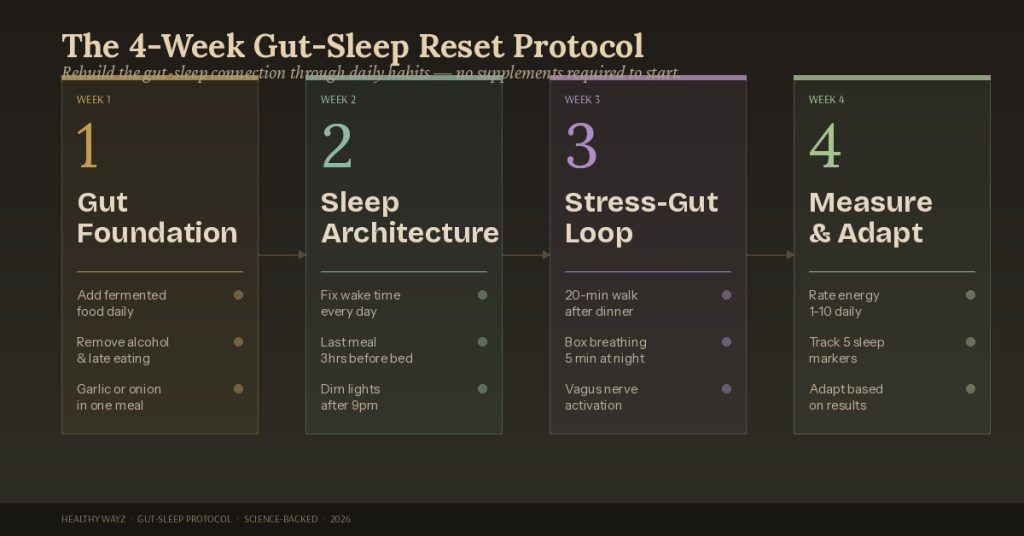
Your Gut-Sleep Reset: A 4-Week Protocol That Works
This is the practical section. The four-week plan below rebuilds the gut-sleep connection through consistent daily habits. It is not a cleanse. It is a structured repair programme.
Each week builds on the one before. Do not skip ahead.
One question before you start: are you willing to change two things in your kitchen this week? If yes, this works.
Week 1: Build the Gut Foundation
Focus entirely on food this week. No sleep changes yet.
Add every day:
- One serving of fermented food: kefir, live-culture yogurt, kimchi, or sauerkraut
- One piece of prebiotic fruit: banana, kiwi, or apple
- Garlic or onion in at least one meal
Remove for the week:
- Alcohol, entirely
- All ultra-processed snacks
- Eating within 2 hours of your bedtime
Most people notice reduced bloating and slightly easier sleep within 5 to 7 days.
Week 2: Repair Your Sleep Architecture
Now you add sleep habits on top of the Week 1 food changes.
Set a consistent sleep window:
- Pick a fixed wake time and hold it every day, including weekends. This single habit is the most well-supported sleep intervention in the research
- Your bedtime follows naturally once your wake time is fixed
Evening gut-sleep routine:
- Last meal 3 hours before bed
- Optional prebiotic snack at 8pm if genuinely hungry: a banana or a small bowl of oats
- Dim lights after 9pm. Light suppresses melatonin production and disrupts your gut bacteria’s own circadian rhythm simultaneously
Estimated daily commitment: 5-10 minutes.
Week 3: Break the Stress-Gut Loop
Chronic stress keeps the gut-brain axis dysregulated even when diet improves. This week adds one stress-reduction practice chosen specifically for its gut benefit.
Walking: Twenty minutes at low intensity after dinner improves gut motility, reduces cortisol, and increases deep sleep duration. The research on this is consistent across multiple study designs. No equipment. No gym. Just 20 minutes outside.
Box breathing: Four counts in, four hold, four out, four hold. Five minutes before bed. This stimulates the vagus nerve, which is the main communication channel of the gut-brain axis. Activating it manually reduces gut spasms and lowers overnight cortisol. ‘For a full bedtime protocol, see our nervous system reset for better sleep guide.
Week 4: Measure Progress and Keep Going
By week four, most people following this protocol notice several clear improvements.
Here is a practical way to track your progress. Each morning, score your energy on a scale of 1 to 10 before you look at your phone. Most people in this protocol move from a consistent 3 or 4 up to a 6 or 7 by day 21. That shift tells you the gut-sleep connection is repairing.
Watch specifically for these five markers:
- Falling asleep within 20 minutes instead of 40 or more
- Waking fewer times through the night
- Reduced morning bloating and more consistent digestion timing
- Stable energy from 2pm to 5pm without needing caffeine
- Fewer evening cravings for sugar and processed food
Not seeing at least two of these by day 28? Go back to Week 1 food changes first. The gut foundation has to be solid before sleep improvements show up reliably. For people with significant gut dysbiosis, a fifth week is normal. That is not failure. Your microbiome took years to reach its current state. Four weeks is genuinely fast.
For readers whose sleep problems trace back to digestion, the gut and sleep connection explains why fixing one often fixes the other, and why citrate can be a smart pick.
Supplements That Support the Gut-Sleep Connection: What the Evidence Says
Food comes first. Always. But three supplements have solid, specific evidence for the gut-sleep connection and are worth knowing about.
Not sure where to start? Go to the magnesium section first. It addresses both gut and sleep simultaneously and carries the strongest overall evidence of the three.
Probiotics for Sleep
The most studied strains for sleep are Lactobacillus rhamnosus and Bifidobacterium longum. When buying a probiotic, check the label for these strains by name. Products that list only “multi-strain blend” without naming strains are not useful for this purpose.
Take probiotics with food, not on an empty stomach. Food buffers stomach acid and significantly improves bacterial survival to the gut. Realistic expectation: you see measurable microbiome sleep improvements in 4 to 6 weeks of consistent use.
Magnesium Glycinate
Magnesium works on the gut-sleep connection from both sides. In the gut, it relaxes smooth muscle, reducing cramping and bloating. In the brain, it activates GABA receptors, which promote sleep onset.
The glycinate form is better absorbed and gentler than magnesium oxide or citrate. 300 to 400mg taken 30 to 60 minutes before bed is the studied effective dose. Roughly 48% of Americans are estimated to be magnesium-deficient. If you try one supplement from this list, start here.
L-Theanine
L-theanine is an amino acid in green tea. A 2024 study found it reduces gut permeability, which is the leaky gut problem that directly links disrupted gut health to broken sleep. It also promotes alpha brain wave activity, which supports calm focus during the day and faster sleep onset at night.
200mg in the morning, either in supplement form or through 2 to 3 cups of green tea, is practical and well-tolerated.
What to Skip
Avoid anything sold as a “gut cleanse” or “sleep detox.” No clinical evidence supports these categories. High-dose melatonin supplements (5mg or more) also carry a caution: regular use at these levels blunts your body’s own melatonin production. If the gut-sleep reset protocol above rebuilds your natural melatonin through your microbiome, you will not need external melatonin.
Always check with your doctor before starting any supplement protocol, especially if you are pregnant, on medication, or managing a diagnosed gut condition.
Frequently Asked Questions About the Gut-Sleep Connection
Can gut problems cause insomnia?
Yes. Gut dysbiosis reduces serotonin and melatonin production, keeps cortisol elevated at night, and drives systemic inflammation that directly disrupts sleep onset and sleep depth. The gut-sleep connection has strong support in peer-reviewed literature including studies from Nature and Cell Host and Microbe.
How long does it take to improve gut health for better sleep?
Most people see gut symptom improvements within 2 to 3 weeks of consistent dietary changes. Sleep improvements typically follow in weeks 3 to 4, because sleep chemistry depends on the microbiome rebuilding first. Clinical dietary intervention studies consistently show measurable results by week 4.
What are the signs that poor gut health affects sleep?
Six key signs: waking tired after a full night, evening bloating or discomfort, difficulty falling asleep when exhausted, gut flare-ups after poor sleep nights, morning anxiety with no clear cause, and consistent 2pm to 4pm energy crashes. Three or more of these together strongly suggest the gut and sleep connection is a factor.
Does eating before bed hurt gut health and sleep?
Timing matters more than simply eating. A large, high-fat meal within 2 to 3 hours of bed forces your gut to work during its biological rest period, suppressing deep sleep stages. A small prebiotic snack such as a banana is fine and may actively support gut bacteria activity overnight.
What probiotics are best for sleep?
Lactobacillus rhamnosus and Bifidobacterium longum have the most specific clinical evidence for sleep quality. Check labels for these strains by name. Strain specificity matters more than CFU count in choosing an effective gut health probiotic.
Is the gut-sleep connection backed by science?
Yes. Multiple peer-reviewed studies published between 2022 and 2025 in Nature Metabolism, Cell Host and Microbe, and Frontiers in Psychiatry have identified and confirmed the biochemical mechanisms linking the gut microbiome to sleep depth, melatonin production, and sleep architecture. This is an active, fast-growing research area.
Your Next Step Starts Tonight
Think back to that Wednesday morning.
Exhausted. Bloated. Confused. Two problems I thought were separate.
They were not. They were the same loop. And the moment I understood the gut-sleep connection, both started to improve.
You do not need to fix your gut perfectly before sleep improves. You do not need perfect sleep before your gut heals. You just need to start pulling the loop in the right direction.
Week 1 takes two changes: add a fermented food and remove one gut disruptor. That is it. Your biology takes care of the rest.
Start tonight. Your gut and your alarm clock will both have better news for you by week three.