
| TL;DR Your nervous system not your habits is the reason you cannot sleep. Stress keeps your sympathetic nervous system running long after your day ends. The fix is a nervous system reset for better sleep: a science-backed sequence that activates the vagus nerve, lowers cortisol, and shifts your body into rest mode. Most people feel the shift on Night 1 and reach consistent deep sleep within 7 to 14 days. To calm your nervous system tonight: (1) double inhale through your nose then a long exhale through your mouth, twice. (2) Apply gentle pressure just below your collarbone for 60 seconds. (3) Lower room temperature to 65 to 67 degrees F. (4) Do 4-7-8 breathing for 5 minutes. This activates vagal nerve stimulation for sleep and triggers parasympathetic dominance within 8 to 12 minutes. |
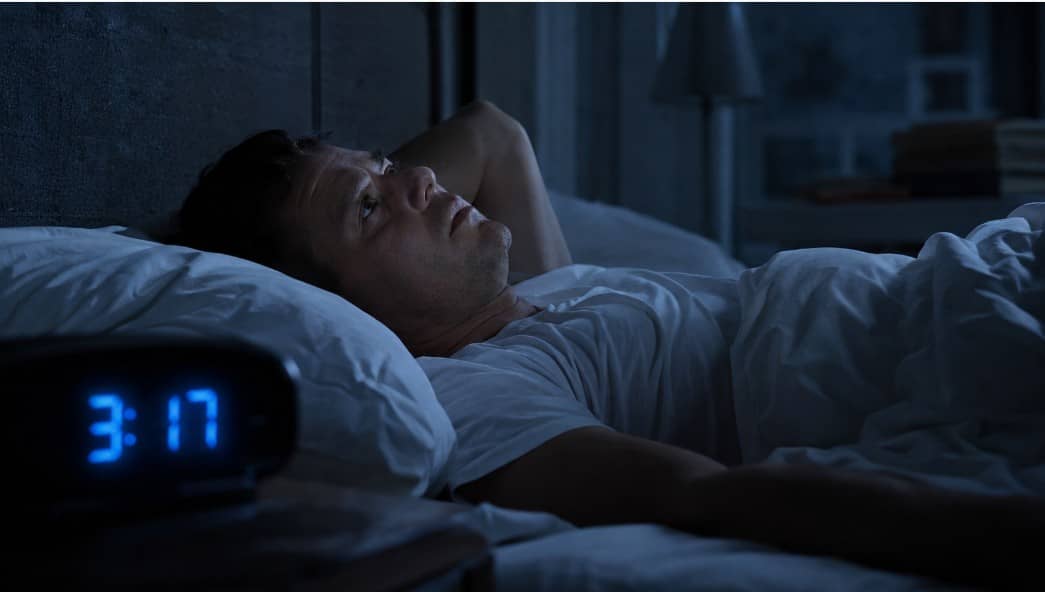
It is 3am. You have been lying there for two hours.
Your body feels like it ran a half-marathon. Your eyes sting. But your brain? It just clocked in for a new shift. You are reviewing tomorrow’s meeting. Replaying that awkward thing you said last Tuesday. Calculating whether 4 more hours of sleep counts as enough to function.
You tried the chamomile. You put the phone down at nine. You even bought the blue-light glasses. And none of it made a real difference.
Sound familiar? You are not broken. You are not alone. More than 1 in 3 adults in the United States do not get enough sleep on a regular basis, according to the CDC. But here is what nobody explains at the doctor’s office.
It is not your phone. It is not your coffee. And it is not your bedtime routine, though those things matter. The real problem is your autonomic nervous system. It is stuck. Still scanning for danger. Still waiting for a threat that already passed hours ago.
The good news is your body already knows how to sleep deeply. It just needs one clear signal that the day is over. That signal is a nervous system reset for better sleep. And this post gives you exactly that.
Before you read further, try this right now. Take a normal inhale through your nose, then immediately top it off with a second short inhale. Then let out a long, slow, complete exhale through your mouth. Do it twice. That is called a physiological sigh. That small act just activated your vagus nerve. The rest of this guide explains why that matters and how to use it every single night.
What Is a Nervous System Reset and Why Does Sleep Depend on It?
Your Nervous System Runs Two Modes
Think of your autonomic nervous system like a car with two pedals and no parking brake.
Mode one is your sympathetic nervous system. It is the accelerator. It raises your heart rate, sharpens your senses, floods your blood with cortisol, and keeps you alert and ready. This is your fight-or-flight state. Brilliant when a real threat appears. A problem when it runs all evening for no reason.
Mode two is your parasympathetic nervous system. It is the brake. It slows your heart, drops blood pressure, eases digestion, and tells every cell in your body the coast is clear. This is your rest-and-digest state. You need it to fall asleep and to stay asleep all the way through the night.
A nervous system reset for better sleep is the deliberate act of shifting from sympathetic dominance into parasympathetic dominance before bed. With consistent practice, most people see measurable improvement in sleep quality within 7 to 21 days. Not months. Weeks.
Why Modern Life Keeps You Stuck in Go Mode
Your nervous system evolved for a world where threats were physical and short. You ran from the predator, escaped, then rested. Threat over. Stress response over.
Today’s threats do not end. Emails arrive at 11pm. Your calendar fills three weeks out. Social media delivers something new to worry about every few minutes. Your amygdala reads all of it as genuine danger because biologically, it has no way to know the difference.
Picture this: you feel wired at 10pm even though you have been awake since 6am. That is not energy. That is cortisol running past its cue to drop. By the time you climb into bed, your jaw is still tight. Your shoulders are still raised. You close your eyes and wait for sleep that does not come because your nervous system is still waiting for the danger to pass.
This is not a willpower problem. It is a biology problem. Calming the nervous system at night requires a biological solution, not a stronger resolve to stop thinking.
We have covered this connection in detail in our post on how your gut and sleep affect each other. The gut-brain axis and the autonomic nervous system share the same communication line: the vagus nerve. Disruption in one accelerates disruption in the other.
How a Dysregulated Nervous System Destroys Your Sleep
Five Signs Your Nervous System Is the Problem
Before you fix it, confirm you are dealing with autonomic nervous system dysregulation and not simply poor habits. Check how many of these you recognise.
- Racing thoughts the moment your head hits the pillow. The day’s noise follows you to bed and starts replaying the moment stimulation stops.
- Waking between 2am and 4am and lying there fully alert. This window maps exactly to a natural cortisol rise. When your baseline is already high, that rise pulls you into complete wakefulness.
- Jaw clenching or shoulder tension during sleep. Your muscles hold unresolved sympathetic activation even while you are unconscious.
- Waking unrefreshed after a full night. You slept the hours but never reached restorative slow-wave sleep because elevated cortisol suppressed it throughout.
- Low-level dread or anxiety at bedtime with no clear cause. This is sympathetic hypervigilance with nowhere to direct itself.
How many did you recognise? Two or more means this is your protocol. Three or more means tonight matters more than any other night this week.
If you recognised two or more, your nervous system is the bottleneck. Not your mattress. Not your screen time. The protocol in Section 4 was built for exactly this state.
The Cortisol Loop That Keeps Breaking Your Sleep
Here is the loop nobody explains clearly. High evening cortisol delays sleep onset by suppressing melatonin production. Poor sleep raises cortisol the following evening. That elevated cortisol delays sleep again. Night after night, the cycle compounds.
Standard sleep hygiene advice no screens, cool room, consistent bedtime addresses the symptoms. It does not touch the cortisol loop at its root. That is why most people follow the checklist for a week, see limited results, and quietly give up.
What if you could interrupt that loop before it started? That is exactly what the vagus nerve makes possible.
The missing variable is your vagus nerve. It is the one pathway through which your body can physically exit stress mode. And most people have never been taught it exists, let alone how to use it.
The Vagus Nerve: Your Body’s Built-In Off Switch
What the Vagus Nerve Actually Does
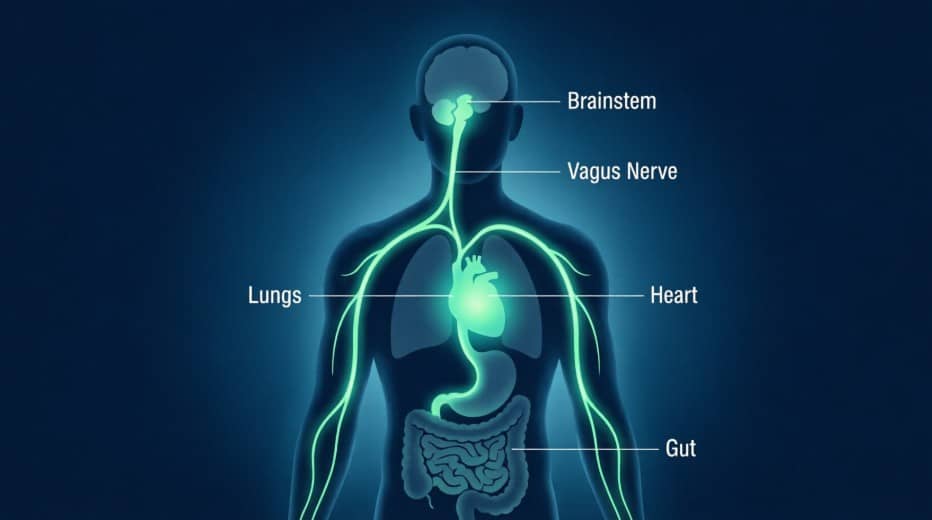
The vagus nerve is the longest nerve in your body. It runs from your brainstem down through your neck, into your chest, all the way to your gut, touching your heart, lungs, and major digestive organs along the route.
It carries roughly 75 percent of all parasympathetic signals between your brain and your body. When your vagus nerve fires properly, your heart rate slows, your breathing deepens, your gut relaxes, and your brain receives the signal that it is safe to lower its guard.
High vagal tone a well-functioning, responsive vagus nerve produces deeper sleep, faster recovery from stress, and better heart rate variability. Low vagal tone means your body stays locked in mild sympathetic activation even at rest, even in bed, even when nothing bad is happening.
Vagal nerve stimulation for sleep works by directly signalling the brainstem to suppress cortisol and allow melatonin to rise. This is not relaxation in the vague sense. It is a documented physiological intervention with a specific, measurable biological pathway.
The Polyvagal Theory Connection
Neuroscientist Stephen Porges developed polyvagal theory to explain how the nervous system moves through three states: safety, mobilisation, and shutdown. Deep sleep requires the safety state what Porges calls the ventral vagal state, or what most of us would simply call the felt sense of physical safety.
When you are stuck in mobilisation mode, your body does not experience your bed as safe. It experiences it as a waiting room. Your nervous system is still scanning. Still ready to act. Bed becomes a place where you lie down and wait for sleep rather than a place where sleep simply happens.
Polyvagal theory and sleep are directly connected. Every technique in the protocol below targets that ventral vagal state the physiological condition your body needs before it allows deep sleep to begin.
This also ties directly into what our circadian health reset guide covers in depth. Circadian rhythm governs when cortisol rises and falls across the day. Your vagal tone determines how high it climbs. Both systems run in parallel and amplify each other.
| Does vagal nerve stimulation for sleep work? Yes. It activates the parasympathetic nervous system, signals the brainstem to reduce cortisol, slows heart rate, and allows melatonin to begin rising. Research confirms a single extended exhalation reduces heart rate within seconds via vagal activation. Daily practice raises vagal tone measurably within 3 to 4 weeks. |
The 6-Step Nervous System Reset Protocol for Tonight
This is not theory. These are specific, sequential actions. Each step targets a different mechanism of sympathetic deactivation. Together they shift your body into parasympathetic dominance in a way most people feel physically within 8 to 12 minutes.
Start with Steps 1 and 2 tonight. Add one step each following night. By Day 6 you are running the full protocol. This staged approach works better than trying everything at once because repetition trains the nervous system. Novelty stimulates it.
Phase One: The 60-Minute Wind-Down
Step 1: Light Shift (9:00pm)
Dim every overhead light in your home by 9pm. Switch lamps to warm-toned bulbs at 2700K or below. Blue light exposure suppresses melatonin production by up to 85 percent according to research published in the Journal of Clinical Endocrinology and Metabolism. That is not a minor effect. That is your sleep hormone being nearly switched off by the light above your couch.
Set room temperature to 65 to 67 degrees Fahrenheit, or 18 to 19 degrees Celsius. Your core body temperature needs to drop to trigger sleep onset. A cool room accelerates that drop far faster than any supplement.
This step tells your circadian clock the suprachiasmatic nucleus (the master clock in your brain that reads light signals) that the day is ending. Light is the strongest external signal it receives. Change the light and you change your biology’s sense of time.
Step 2: Physiological Sigh (9:15pm)
This is the fastest evidence-backed technique for reducing acute sympathetic nervous system activation. Stanford neuroscientist Andrew Huberman’s research confirmed that the physiological sigh reduces autonomic arousal faster than any other single breathing method tested.
Here is how to do it. Take a normal inhale through your nose. Before you exhale, take one more short inhale on top just a small top-up. Then release a long, slow, complete exhale through your mouth. Do this twice.
The double inhale fully re-inflates collapsed alveoli in your lungs. The long exhale activates your vagus nerve through the resulting pressure change in the chest. Your heart rate drops. Your muscles soften slightly. You feel it within seconds. That physical shift is your nervous system beginning to stand down.
Step 3: 4-7-8 Breathing for Vagal Activation (9:30pm)
This is the core vagal nerve stimulation for sleep technique. Inhale through your nose for 4 counts. Hold for 7. Exhale through your mouth for 8. The extended exhale is the mechanism it outlasts the inhale, and that asymmetry directly activates the vagal brake.
Do this for 5 minutes. Your nervous system does not need a marathon. It needs a consistent nudge. A daily 5-minute practice produces faster nervous system learning than a 20-minute session done twice a week.
If the 7-count hold feels uncomfortable, reduce to 4-4-6. The exhale-to-inhale ratio is the key variable, not the specific counts.
Phase Two: The Pre-Bed Reset
Step 4: Progressive Muscle Release (9:50pm)
Here is what most people miss about this step: your body stores today’s stress as physical tension, not memory. Your muscles are still holding the meeting, the commute, the argument. This technique releases that grip.
Tense your feet for 5 seconds. Fully release for 10. Move to your calves, thighs, abdomen, hands, arms, shoulders, jaw. The whole sequence takes about 7 minutes. The tension-release cycle sends a safety signal through your proprioceptive system (the system that reads tension and position across your muscles and joints), interrupting the physical holding pattern that keeps sympathetic activation running while you lie still.
Give extra attention to your jaw. Most people clench without knowing it. A tight jaw tells your brainstem you are still bracing for something. Releasing it deliberately changes that signal.
Step 5: Gratitude Anchor (9:57pm)
Name 3 specific things that happened today that went well. Not ‘my health and family’. Specific: the coffee was exactly right this morning. Your colleague laughed at the joke you made. The afternoon light through the window looked nice for about 10 minutes.
Specificity is the mechanism, not positivity. Specific recall activates the prefrontal cortex and pulls neural activity away from the amygdala’s threat-scanning loop. It is a pattern interruption, not a mood exercise.
A 2015 study published in Psychotherapy Research found that writing specific gratitude statements reduced bedtime cognitive arousal the clinical term for racing thoughts that prevent sleep significantly more than general positive reflection.
Step 6: Vagal Stimulation via Gentle Pressure (10:00pm)
Apply light pressure with two fingers just below your collarbone and hold for 60 seconds. This area sits directly over the vagal nerve pathway. Sustained gentle pressure stimulates the nerve mechanically.
Follow with soft humming or a low-pitched vocal tone for 30 seconds. The vagus nerve runs through your throat. Vocal vibration activates it through a different pathway than breathing does. The two methods together produce a compounding effect.
Finally, massage gently just behind your ear and along the jaw line. This is the auricular branch of the vagus nerve one of the most accessible stimulation points on the body.
Combined with the breathing from Steps 2 and 3, this sequence produces measurable parasympathetic nervous system activation within minutes. Most people report a heaviness in the limbs and a slowing of thought. That is your body preparing for deep sleep.
| Save this table to your phone. You will use it every night for the next 21 days. | ||
| Time | Action | Primary Mechanism |
| 9:00 pm | Dim lights to warm tone. Set room to 65-67 F. | Circadian cortisol signal |
| 9:15 pm | Physiological sigh x 2. | Acute sympathetic deactivation |
| 9:30 pm | 4-7-8 breathing for 5 minutes. | Vagal nerve activation |
| 9:50 pm | Progressive muscle release, feet to jaw. | Proprioceptive safety signal |
| 9:57 pm | 3 specific gratitude anchors. | Prefrontal amygdala interruption |
| 10:00 pm | Collarbone pressure plus humming, 60 seconds. | Mechanical and vibratory vagal stimulation |
| 10:02 pm | Sleep. | Parasympathetic dominance achieved |

Build Vagal Tone During the Day So the Night Gets Easier
The overnight protocol works from Day 1. Your long-term results improve significantly when you also raise your baseline vagal tone during the day. Think of it this way: the nightly reset is the technique. Daily habits are the training behind the technique.
The protocol above handles tonight. The habits below handle the 16 hours before tonight and they determine how quickly the reset takes hold.
Morning: Cold, Light, and Breath
Splash cold water on your face for 30 seconds first thing. This triggers the dive reflex one of the strongest acute vagal activations the body can produce without equipment. Your heart rate drops noticeably. Your nervous system receives a rest signal before the day even begins.
Step outside within 30 minutes of waking and get 5 to 10 minutes of natural light into your eyes. As our circadian health reset guide covers in depth, morning light sets the primary timing signal for your circadian cortisol curve. Get the timing right in the morning and your evening cortisol drops on schedule.
Do 3 minutes of slow diaphragmatic breathing before checking your phone. Inhale for 4 counts, exhale for 6. Belly rises on the inhale, falls on the exhale. This grounds your nervous system in a low-arousal state before the day’s inputs arrive.
Afternoon: Silence and Stimulation
Take a 10-minute walk with no audio. No podcast. No music. Just movement and ambient sound. Unstructured silence allows your default mode network to process the day’s accumulated stress. This reduces the emotional backlog that shows up as nighttime rumination.
Cut caffeine after 1pm. Caffeine blocks adenosine receptors. Adenosine is the brain chemical that builds sleep pressure throughout the day. Block its receptors in the afternoon and your sleep pressure is lower at night, which forces your body to compensate with more cortisol. That cortisol feeds directly into the loop you are working to break.
Five minutes of alternate nostril breathing (nadi shodhana) during the afternoon energy dip has documented effects on heart rate variability, a direct measure of vagal tone. Close your right nostril, inhale through the left, switch, exhale through the right. Inhale right, switch, exhale left. That is one cycle.
Evening Nutrition That Supports the Reset
Take 200 to 400mg of magnesium glycinate with dinner. Magnesium supports GABA production your brain’s primary inhibitory neurotransmitter and essentially its volume dial for neural activity. More GABA at night means a quieter mind at bedtime. Many adults run mildly deficient without ever knowing it.
Include tryptophan-rich foods in dinner a few nights per week. Turkey, eggs, pumpkin seeds, and firm tofu all feed the serotonin precursor chain. Serotonin is the raw material your brain converts to melatonin overnight. As our gut-sleep connection post explains, 90 percent of your serotonin is manufactured in your gut which is exactly why gut health and sleep quality are inseparable systems.
Avoid alcohol as a sleep aid. It depresses the central nervous system initially, which mimics sedation. But it suppresses REM sleep in the second half of the night, raises cortisol from around 2am onwards, and directly reduces vagal tone. You fall asleep faster. You do not sleep well. The difference matters more than most people realise.
What to Expect: A Realistic 30-Day Timeline
Here is an honest answer based on what the research shows and what people who practice this consistently report.
| Timeframe | What Changes |
| Night 1 | Heart rate drops during the breathing protocol. You feel the physical shift even if sleep onset does not dramatically improve yet. |
| Days 3 to 5 | Sleep onset time reduces. Racing thoughts at bedtime become less frequent and less intense. |
| Days 7 to 10 | Middle-of-the-night waking decreases. The cortisol loop begins to break. |
| Days 14 to 21 | You wake feeling genuinely rested. Heart rate variability improves measurably if you track it. |
| Day 30 and beyond | Vagal tone is measurably raised. The protocol now takes about 8 minutes instead of 15. Most people report it feels less like a routine and more like coming home. |
This timeline is conservative. The physiological sigh produces a measurable heart rate drop in under 60 seconds on Night 1. Most people feel something immediately.
The most common failure pattern: people feel better after Day 5 and stop the protocol. The goal is not to do this until you feel better. The goal is to do this until your nervous system is genuinely recalibrated. That takes about 21 consistent days.
What would your mornings look like if you woke up feeling genuinely rested for the first time in months? Keep going and you will know.
Frequently Asked Questions
The most common questions about this protocol come next. Read them even if you feel clear on the steps. The answers often explain what goes wrong when people stop seeing results.
Q1: What is the fastest way to reset your nervous system before bed?
The physiological sigh is the fastest documented technique. A double inhale through the nose followed by a long complete exhale through the mouth, repeated twice, reduces sympathetic nervous system activation within seconds. It works by fully deflating the lungs and triggering the vagal brake through the resulting pressure change in the chest cavity.
Q2: How long does vagal nerve stimulation for sleep take to work?
A single session of vagal nerve stimulation for sleep shifts the body toward parasympathetic dominance within 8 to 12 minutes for most adults. Consistent daily practice raises vagal tone over 3 to 4 weeks, meaning each nightly reset becomes progressively faster as the baseline improves.
Q3: Can you fix a dysregulated nervous system at home without medication?
Yes. Breathing techniques, temperature regulation, progressive muscle relaxation, and vagal stimulation exercises are all non-pharmaceutical interventions with documented physiological effects. For dysregulation lasting more than 3 months, a functional medicine practitioner or somatic therapist adds meaningful support.
Q4: Why do I wake between 2am and 4am and cannot get back to sleep?
This waking window maps to a natural cortisol rise the body uses to prepare for dawn. When your baseline cortisol is already elevated, this rise pulls you into full wakefulness. A consistent nervous system reset for better sleep lowers your baseline cortisol over 7 to 14 days and reduces or eliminates this pattern.
Q5: Does cold exposure help with sleep quality?
Morning cold exposure raises daytime vagal tone significantly. The dive reflex triggered by cold water on the face is one of the strongest non-invasive vagal activations available. Close to bedtime, keep any cold exposure mild. Full cold immersion within 2 hours of sleep temporarily raises cortisol, which works against the protocol.
Q6: Is the vagus nerve the same as the parasympathetic nervous system?
Not exactly. The vagus nerve is the primary nerve of the parasympathetic nervous system, carrying approximately 75 percent of all parasympathetic signals between brain and body. Stimulating it is the most direct and accessible way to activate the rest state your body requires for deep sleep.
Browse more from the Healthy Wayz sleep library or subscribe to our weekly health brief for new protocols every Thursday.
Sources and Further Reading
The three sources below are the primary research behind every technique in this guide. Each is peer-reviewed or published by a named neuroscientist. Read them if you want to go deeper than the protocol.
- Huberman Lab — Physiological Sigh Research, Stanford Neuroscience – primary source on the physiological sigh as the fastest documented sympathetic deactivation technique.
- Porges S.W. — Polyvagal Theory and the Autonomic Nervous System, Norton (2011) – foundational framework for understanding why vagal tone governs both stress response and sleep quality.
- Leproult R., Van Cauter E. — Effect of Sleep Restriction on Cortisol, JAMA 2011 – illustrates the cortisol-sleep loop and how chronic restriction compounds hormonal dysregulation nightly.
The Signal Your Body Has Been Waiting For
You have been managing sleep with willpower. Maybe with supplements. Probably with promises to yourself about screens and caffeine. And it has helped, partially, some nights.
But partial results are just another form of the same problem.
Your nervous system already knows how to sleep. It does not need new information. It needs one clear biological signal that the day is over and the threat has passed. That signal is what this protocol delivers.
Tonight, try just Steps 1 and 2. Dim the lights at 9pm. Do two physiological sighs. Notice what happens in your body. That small shift is your parasympathetic nervous system beginning to respond. Build from there.
Come back tomorrow night and add Step 3. In seven days you will be running the full sequence. And in fourteen days, if you stay consistent, you will wake up one morning and notice something has shifted. Your body will feel like yours again.
| Start Tonight Bookmark this page. Share it with the one person who has mentioned they cannot sleep. You already know who that is. Read next from Healthy Wayz: Read: Your Gut Is Ruining Your Sleep. Here Is How to Fix Both Tonight. Read: Circadian Health Reset: Eat, Sleep and Move by Your Body Clock Read: Biohacking for Longevity: Science-Backed Habits |